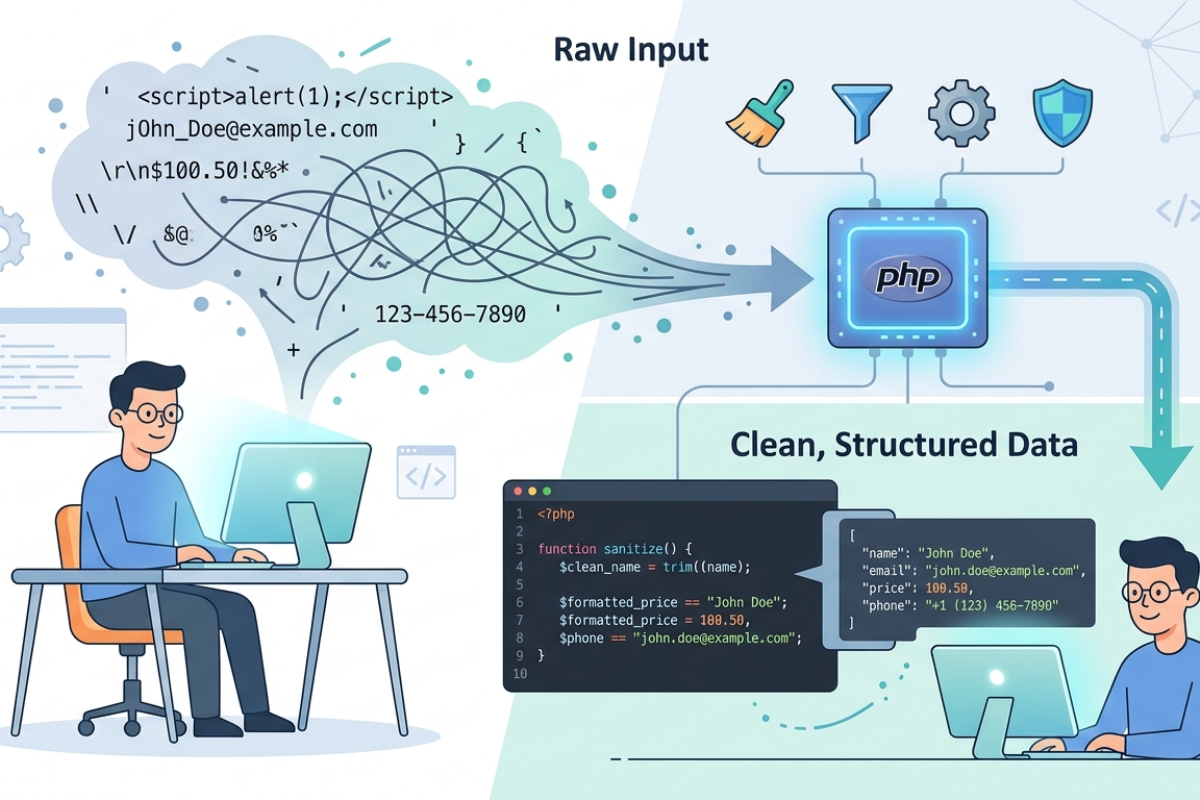
Raw input is unpredictable. It comes from forms, APIs, uploaded files, and user-generated content. Some inputs are clean. Most are not. Extra spaces, inconsistent casing, hidden characters, and unexpected delimiters can quickly break logic in PHP applications. Before data reaches your core logic, it needs to be cleaned, normalized, and structured properly. This step reduces bugs, improves performance, and ensures consistent behavior across your system.
Quick Overview
- Raw strings often contain inconsistencies that affect application behavior
- Cleaning input improves validation, storage, and processing accuracy
- Normalization ensures predictable formatting across all inputs
- Simple PHP functions can eliminate common input issues
- Structured data leads to fewer errors and easier debugging
The Real Problem with Raw Input Strings
Input data rarely arrives in a perfect format. A user might paste text with extra whitespace. Another might submit inconsistent capitalization. APIs might return strings with unexpected separators. These issues are subtle, but they compound quickly. A search function might fail because of casing differences. A comparison might break due to hidden characters. A database entry might store duplicates simply because formatting varies.
Handling these inconsistencies manually across different parts of an application creates technical debt. The better approach is to clean input at the earliest stage. This means transforming raw strings into a predictable structure before any validation or processing begins. Once the data is consistent, the rest of your logic becomes simpler and more reliable.
Breaking Down Input Before Processing
One of the first steps in handling raw strings is splitting them into manageable parts. Long strings often contain multiple values separated by commas, line breaks, or custom delimiters. Trying to process them as a single block increases complexity and error risk. Splitting them into structured units allows PHP to handle each part individually.
Using tools that help split texts into lines makes this process faster and more accurate. Once separated, each line or value can be trimmed, validated, and transformed independently. This reduces ambiguity and ensures that no data gets lost during processing.
In PHP, functions like explode() and preg_split() are commonly used for this purpose. They allow developers to define clear boundaries within strings. Combined with trimming functions, these tools create clean arrays ready for further operations.
How Structured Data Improves Application Logic
Structured data removes guesswork. When every string follows the same format, your application behaves predictably. This becomes especially important in features like filtering, searching, and sorting. A consistent structure ensures that comparisons are accurate and reliable.
Developers working on data-heavy features can benefit from the techniques discussed in split texts into lines. These methods highlight how organizing raw input into defined formats simplifies downstream operations. Instead of constantly adjusting logic to handle edge cases, you standardize the input once and reuse it across the system.
This approach also improves maintainability. New developers can understand the data flow quickly because the input format remains consistent throughout the application.
Normalizing Case for Consistency
Case inconsistency is one of the most common sources of bugs. A username entered as “JohnDoe” might not match “johndoe” in a database query. A tag written in uppercase might fail to match lowercase entries. These mismatches create confusion and unexpected behavior.
Converting all input to a consistent case eliminates this issue. Whether you choose lowercase, uppercase, or title case depends on your application. The key is consistency. Using tools that convert text case helps standardize strings before they reach your logic layer.
In PHP, functions like strtolower(), strtoupper(), and ucwords() are simple but powerful. They ensure that comparisons work as expected and reduce the risk of duplicate entries caused by casing differences.
Handling Whitespace and Invisible Characters
Whitespace issues are often overlooked. Leading spaces, trailing spaces, and multiple spaces between words can all affect how data is processed. These issues are not always visible, but they can break validation rules and comparisons.
PHP provides built-in functions like trim(), ltrim(), and rtrim() to remove unwanted spaces. For more complex cases, regular expressions can be used to replace multiple spaces with a single one. This ensures that strings remain clean and readable.
Invisible characters such as tabs and line breaks can also create inconsistencies. Normalizing these characters into a standard format ensures that your application treats all input uniformly.
Step-by-Step Cleaning Workflow
Cleaning input strings becomes easier when you follow a consistent workflow. Instead of applying random fixes, you create a repeatable process that handles all common issues.
1. Trim leading and trailing whitespace
2. Normalize line breaks and spacing
3. Convert text to a consistent case
4. Split strings into structured arrays
5. Remove duplicates and invalid entries
Each step builds on the previous one. By the time the data reaches your application logic, it is clean, structured, and predictable. This reduces the need for additional checks and simplifies debugging.
Common PHP Functions for String Cleaning
| Function | Purpose | Example Use |
|---|---|---|
| trim() | Removes leading and trailing spaces | Cleaning form inputs |
| explode() | Splits the string into an array | Parsing CSV values |
| strtolower() | Converts text to lowercase | Standardizing usernames |
| preg_replace() | Pattern-based replacement | Removing extra spaces |
Preventing Duplicate and Corrupt Data
Duplicate data is often caused by inconsistent formatting. Two values might look different but represent the same information. Cleaning input ensures that duplicates are detected and handled correctly.
Using functions like array_unique() after cleaning helps remove repeated entries. Combined with trimming and case normalization, this ensures that only valid and unique data is stored. This approach is especially useful in tagging systems, email lists, and user-generated content platforms.
For deeper validation, developers can refer to the practices outlined in the postal code validation. These examples show how structured input improves accuracy when working with external data sources.
Security Benefits of Clean Input
Cleaning input is not only about formatting. It also plays a role in security. Malicious input often hides within poorly formatted strings. Extra spaces, encoded characters, and unexpected patterns can bypass basic validation checks.
By normalizing input before validation, you reduce the risk of injection attacks and malformed data. Sanitized strings are easier to validate and safer to store. This step strengthens the overall security of your application.
Guidelines from OWASP highlight the importance of input validation and sanitization in preventing common vulnerabilities. Applying these principles early in your data flow creates a stronger defense against attacks.
Practical Example in PHP
Here is a simple example that demonstrates how to clean and format raw input strings in PHP:
$input = "  Apple, banana ,  ORANGE,apple ";

$clean = strtolower(trim($input));
$parts = array_map('trim', explode(',', $clean));
$unique = array_unique($parts);

print_r($unique);
This example trims whitespace, converts text to lowercase, splits the string into an array, and removes duplicates. The result is a clean and structured dataset ready for processing.
Making Input Cleaning Part of Your Workflow
Cleaning input should not be an afterthought. It should be part of your development workflow from the beginning. By standardizing how input is handled, you reduce errors and improve code quality.
Automating this process through helper functions or middleware ensures consistency across your application. Instead of repeating the same logic in multiple places, you centralize it and reuse it wherever needed. This approach saves time and reduces maintenance effort.
Shaping Reliable PHP Applications Through Clean Data
Applications depend on data. If the data is messy, the application becomes unpredictable. Clean input creates a stable foundation for everything else. It simplifies validation, improves performance, and reduces debugging time.
Developers who invest time in cleaning and formatting input strings build more reliable systems. The logic becomes clearer. Errors become easier to trace. Features behave consistently across different scenarios.
Small improvements in input handling lead to significant gains in application stability. Over time, these improvements compound, resulting in a cleaner codebase and a better user experience.
No Responses